China vs. the World: The Supply-Chain Question
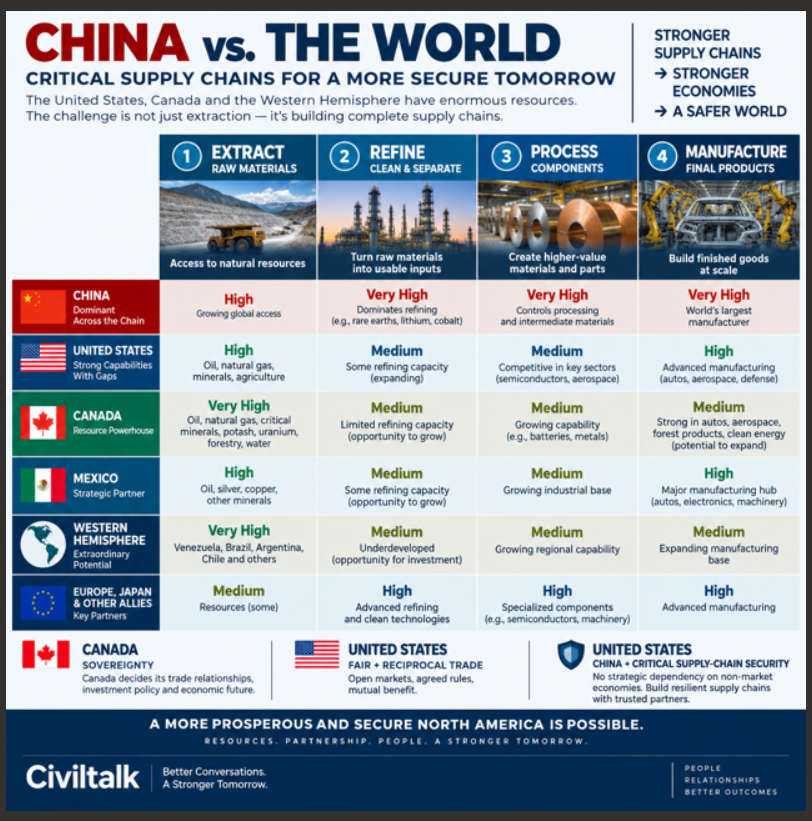
The graphic below may explain much of what is happening in global trade right now.
At the G20 finance ministers meeting this week, something remarkable happened: 19 G20 members agreed that non-market policies and persistent streams of artificially cheap exports creating global trade imbalances need to be addressed.
China was the only dissenter.
And importantly: Canada agreed with the other 18.
That tells us that this isn’t simply Trump vs. China, and it isn’t simply USA vs. Canada.
Much of the world increasingly recognizes the same strategic problem. For decades we focused on where resources came from and where the final product was manufactured. That’s no longer enough. We have to understand the entire supply chain: EXTRACT → REFINE → PROCESS → MANUFACTURE. Who controls each step?
The Western Hemisphere and trusted allies possess enormous resources—oil, natural gas, copper, lithium, nickel, uranium, potash, rare earths and more. But having minerals in the ground doesn’t create supply-chain security if China dominates the refining, processing or manufacturing necessary to turn them into batteries, semiconductors, AI infrastructure, energy systems, defense equipment and advanced technology.
That’s why the objective shouldn’t be isolation from China. It should be: STRATEGIC OPTIONALITY.
Never again allow a critical supply chain to exist without another option.
Build enough capability across the USA, Canada, Mexico, the Western Hemisphere and trusted allies that no single country can shut down a critical supply chain.
And here’s what makes the Canada–USA dispute particularly interesting: Canada apparently agrees with the underlying diagnosis.
At the G20, Canada joined the other members in supporting action on these non-market distortions. China stood alone.
So perhaps the disagreement between Canada and the USA isn’t really about whether there is a China problem. It’s about what North America should do about it.
That brings us back to the “three red lines” of the Canada - USA agreement:
1) CANADA: SOVEREIGNTY. Canada controls its own trade and investment policy.
2) USA #1: FAIR + RECIPROCAL TRADE. Fair rules and market access. Then let markets determine the trade balance.
3) USA #2: CHINA + CRITICAL SUPPLY-CHAIN SECURITY. Preferential North American trade cannot recreate strategic dependence on China or become a back door for non-market production.
Those objectives aren’t inherently incompatible. In fact, they point toward an enormous opportunity: EXTRACT HERE. REFINE HERE. PROCESS HERE. MANUFACTURE HERE.
Not everything has to happen in the USA. Build it across North America, the Western Hemisphere and trusted allies. 19 agreed there is a problem. Canada was one of them. China was the only one that didn’t.
Now Canada and the USA need to negotiate what they’re going to do about it, using their Conversational Intelligence. Let’s Clarion this!
Civiltalk | The Conversational Intelligence Company
Better Conversations → Stronger Relationships → Better Outcomes