All playbooks
Conversation Playbook
Civil Conversations with [Group Name] — Powered by Clarion CI
Moderator / Facilitator
Different perspectives. One conversation. AI as a resource. Conversational Intelligence as the guide.
Better Conversations | Stronger Relationships | Better Outcomes
Use this to run a facilitated conversation among 2–5 people with genuinely different perspectives on an issue — in person or online — where the group periodically asks a question of an AI tool, examines its answer together, and continues the human conversation with what they learned. The goal is understanding, not a winner.
Before the conversation
- Set the frame up front: this is not a debate, and there's no score. Success looks like "we still disagree, but we understand why" — not consensus, and not a winner.
- Choose participants for genuine difference of perspective, not for opposite extremes performing for an audience. The goal is real understanding between people who actually see it differently.
- Agree on a few conversation principles before starting, and agree on who decides when it's time to "Ask AI" — usually the moderator, on behalf of the group.
- Introduce "Let's Clarion This!" as the group's spoken cue to pause and consult AI — it's meant to be a fun, recognizable moment in the room, not a formal procedure.
- Be explicit that the AI is a resource to question, not a referee or a source of truth. The group's job is to interrogate its answer, not accept it.
How a conversation runs
- Participants open with their own perspectives on the issue, in their own words, before AI enters the conversation at all.
- At a natural point, the moderator says, "Let's Clarion This!" — the group's cue to pause and frame a question for AI together.
- The AI's answer becomes something to examine, not accept: Is it accurate? What assumptions is it making? What's missing? Is the wording neutral? What follow-up question would sharpen it?
- The human conversation continues, using — or disagreeing with — what the AI offered.
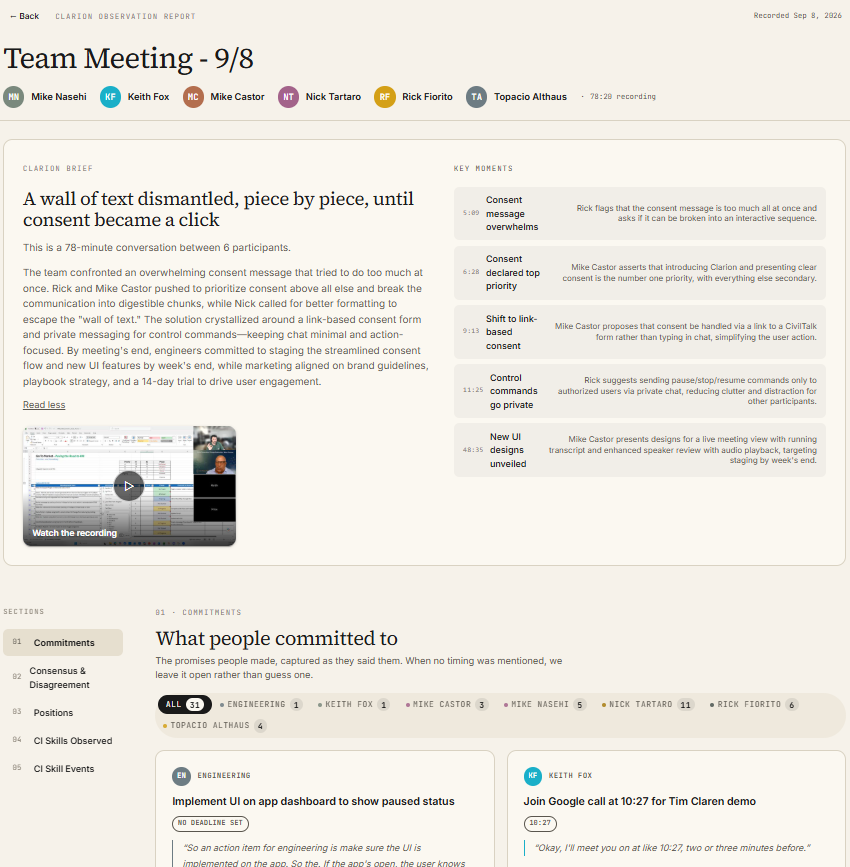
- Clarion observes the entire conversation and afterward produces a Conversational Intelligence report: positions, agreement, disagreement, and how the conversation actually unfolded.
- Close by discussing both intelligences: what did we learn about questioning AI, and what did we learn about talking to each other?
Ask across all four domains
Self-Awareness
- "Before we ask AI anything — what's your own instinct here, and where do you think that instinct comes from?"
- "Now that you've seen the AI's answer, has your thinking shifted, or are you holding the same position for the same reasons?"
Self-Management
- "If that answer challenged your view just now, how are you sitting with that?"
- "What would it take for you to say 'I hadn't considered that' out loud right now?"
Social Awareness
- "What's the strongest, most reasonable version of the perspective you disagree with?"
- "Where do you think you and the person across from you actually agree, even if neither of you has said so yet?"
Relationship Management
- "What follow-up question should we ask AI to get a fuller picture?"
- "What's one thing we agree on now that we didn't at the start of this conversation?"
Connecting to the two intelligences
The format is built around two capabilities that are easy to conflate but genuinely different:
Conversational AI
How the group questions the machine — accuracy, assumptions, missing perspectives, neutrality of wording, and what to ask next. Any conversational AI tool can play this role in the room, as a resource to interrogate.
Conversational Intelligence
How the humans communicate with each other. Clarion observes this independently — agreement, disagreement, listening, empathy, conflict management, and commitments — and reports back afterward through the CivilTalk Conversational Intelligence Skills Model.
Two Different Roles for AI
A conversational AI tool can be invited into the discussion as a resource to question. Clarion's role is different: it observes the humans and helps them understand what happened, how it happened, and why it mattered.
What you'll be able to see afterward
- Whether the group genuinely engaged with the AI's answer or just accepted it — the exact habit this format is built to strengthen.
- A clear, shared account of where real agreement and disagreement exist, once the report separates positions from personalities.
- Which questions are still open and which assumptions were actually contested — the material for a "what we heard" style close to the conversation.
Moderator reminders
- Success isn't consensus. "We still disagree, but we understand why" is a genuinely successful outcome — don't push the group past that toward false agreement.
- Don't let the AI's answer become the referee. The group questioning it is the whole point, not a detour from the real conversation.
- End every conversation the same way: what did we learn about using AI, and what did we learn about talking to each other?